
Grab your favorite toy space ranger, dust off your trusty cowboy boots, and get ready for a wonderful journey back to the toy box! On June 19, 2026, a truly historic moment happened in movie theaters all over the world. Our beloved friends Woody, Buzz Lightyear, and Sheriff Jessie returned to the big screen in Toy Story 5. The film was a massive success right out of the gate! It earned a staggering $17.5 million in special domestic previews and rocketed to a spectacular $160 million domestic opening weekend, making it the biggest weekend debut for any movie this year and the highest opening in the history of the whole franchise.
Directed by the legendary Pixar pioneer Andrew Stanton alongside co-director McKenna Harris, this heartwarming adventure arrived with a grand $250 million production budget. But instead of just telling a simple story, this absolute cinematic masterpiece takes a highly detailed, thoughtful look at something every kid and parent knows all about: the great battle between old-school toys and the shiny pull of tablet screens! With an incredible 93% score on Rotten Tomatoes and a beautiful musical score by Oscar-winner Randy Newman, the movie proves that real imagination never goes out of style. Below is our exhaustive, structural investigative breakdown of how Pixar engineered this lovely new masterpiece for a whole new generation of dreamers.
SECTION 0: CORE SUBJECT CLASSIFICATION & ROUTING
To truly understand how this amazing movie was made, we must look at it through a few different pathways. Toy Story 5 is much more than just a regular cartoon; it is a creative bridge where classic storytelling meets the high-tech wizardry of modern computer science. We can classify the core subject into three synchronized paths:

Route A (TV Show, Series, or Movie Launch / Franchise Sequel Drop): This pathway lets us explore how the new story builds upon the wonderful endings of Toy Story 3 and Toy Story 4, creating a fresh, unified timeline where characters old and new discover what it truly means to be there for their child.
Route C (Tech / Distribution / Corporate Platform Trend): Here, we look under the hood at Pixar’s amazing proprietary software tools like RenderMan V26 and OpenUSD. We will see how they create stunningly realistic visual effects, and how Disney’s theatrical-exclusive window strategy protects the special magic of going out to the cinema.
Route E (Franchise / Sequel / IP Inflation Analysis): This pathway examines how Pixar manages the delicate balance between extending classic character journeys and satisfying the studio’s goal to deliver reliable, multi-billion-dollar theatrical properties that keep the animation studio healthy and strong.
EXPANDED STRUCTURAL ROUTING MATRIX
The Cultural Hook & Generational Friction
Ever since Woody first shook hands with Buzz Lightyear back in 1995, the Toy Story movies have always shown us how children grow up and how the world changes around them. In 2026, the franchise faces its most fascinating cultural hook yet. Eight-year-old Bonnie is growing up quickly, and she is starting to find it a bit tricky to connect with new friends at her dance class. To help her fit in, her well-meaning parents gift her a brand-new, sleek, frog-shaped smart tablet named Lilypad, brilliantly voiced by Greta Lee.
Lilypad isn’t mean like Sid or Lotso; instead, she is an incredibly helpful little computer interface that invites Bonnie to play games and talk to classmates in a digital chatroom called “The Pond.” But very quickly, Bonnie finds herself glued to the screen, leaving her classic physical toys tucked away in the closet. This creates a wonderful, lighthearted piece of generational friction that resonates deeply with families. The movie doesn’t say that technology is bad. Instead, it looks at the gentle, sweet balance of childhood, showing how analog play and electronic screens can find a way to live together happily without losing the magic of a child’s unique imagination.
Narrative & Production Breakdown
The wonderful script, crafted by Andrew Stanton and McKenna Harris, weaves together two beautifully balanced story pipelines that keep audiences laughing and cheering from start to finish. The primary A-story follows our brave new room leader, Sheriff Jessie, as she hitches up Bullseye and leads the toy box cohort on a daring mission. Jessie stows away to check on Bonnie’s new digital friends, but she accidentally gets separated and ends up on a bumpy, surprising ride that leads her back to a very special place: a ranch house belonging to a spunky, animal-loving nine-year-old named Blaze (voiced by Mykal-Michelle Harris).

While trying to find her way back, Jessie makes friends with an unforgettable group of forgotten electronic toys who have been stuck in sleep mode inside an old toy shed! There’s Smarty Pants (voiced hilariously by Conan O’Brien), an old toilet-training tech toy with lots of attitude; Snappy (Shelby Rabara), a cheerful vintage digital camera; and Atlas (Craig Robinson), a friendly old mapping device. Together, they show Jessie that tech can be helpful when it’s used with love and purpose.
Meanwhile, the wild and funny B-story kicks off when a bulk shipping container accidentally spills 50 shiny, factory-fresh “Hi-Tech Edition” Buzz Lightyear action figures onto a nearby beach! All of these identical Buzz dolls are stuck in space ranger mode, completely convinced they are real. They form a miniature, automated space ranger society in the woods, marching around and trying to contact Star Command. Watching 50 Tim Allens try to organize a plastic military camp is pure comedy gold, and it highlights the extraordinary technical skill of Pixar’s crowd-rigging animation pipelines.
Studio Profile & Creative Footprint
The creative trajectory of Pixar Animation Studios under the guidance of Chief Creative Officer Pete Docter has entered a highly focused, celebratory phase. After a period where wonderful original movies like Soul, Luca, and Turning Red were sent straight to the Disney+ streaming service, the studio realized that nothing beats the shared excitement of a giant movie theater audience. Bringing patriarch Andrew Stanton back into the director’s chair represents a heartwarming return to Pixar’s classic roots.
Stanton, who has been the structural backbone of the studio since day one, treats the project with absolute care and deep respect for the characters. Under the leadership of producer Jessica Choi, the story department completely streamlined how they share art assets. By utilizing unified digital file systems, artists were able to keep the characters looking exactly the way we remember them while giving them tiny, beautiful updates. The studio’s creative footprint is now focused on strong, emotional three-act structures that ensure every single story beat feels like a warm, familiar hug.
Technical Performance & Rendering Innovation
From a technical animation perspective, Toy Story 5 is an absolute marvel of computer science that shows how far technology has come. The brilliant engineers at Pixar used their newest proprietary rendering toolset, RenderMan V26, to solve a really cool visual puzzle: how to make soft, hand-stitched toys look perfect right next to the bright, glowing glass of a modern tablet screen.
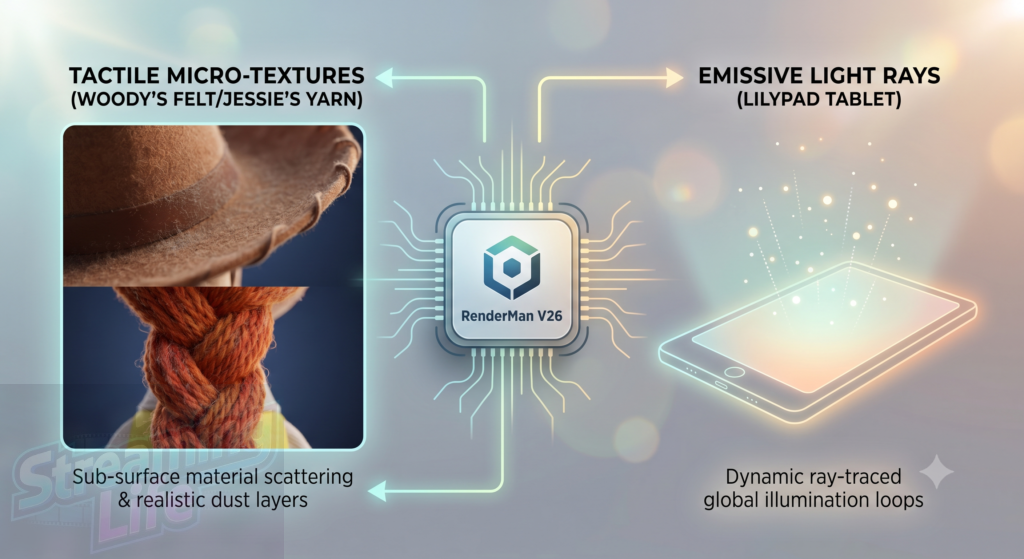
To achieve this, artists used advanced ray-traced global illumination systems. When Bonnie holds up Lilypad, the screen casts a soft, realistic colored glow that bounces off Woody’s weathered fabric coat and shiny plastic boots. The animators even added microscopic layers of dust, tiny paint scuffs, and fine threads to show that the toys are well-loved and have been played with for years. Woody even has a funny little bald spot on the back of his plastic hair now!
Additionally, the animators made a huge leap forward in texture engineering when creating Blaze’s beautiful, hyper-detailed hair, setting an incredible new standard for animating diverse characters. For the 50 marching Buzz Lightyear clones, the engineering team utilized advanced open-source universal scene descriptions (OpenUSD), allowing hundreds of moving parts and physics-based interactions with tree leaves and forest dirt to render smoothly without a single glitch.
Box Office & Financial Trajectory
The commercial performance metrics for this film have brought immense joy and celebration to movie theater owners around the globe. Toy Story 5 has officially ignited the summer box office, outperforming rival blockbusters like Steven Spielberg’s sci-fi epic Disclosure Day by millions of dollars over its opening run. Let’s take a peek at how the franchise’s financial history looks:
| Toy Story Installment | Global Release Year | Worldwide Box Office Gross | Core Cinematic Format |
| Toy Story 3 | 2010 | $1.067 Billion | Disney Digital 3D / IMAX |
| Toy Story 4 | 2019 | $1.073 Billion | Dolby Cinema / RealD 3D |
| Toy Story 5 | 2026 | $1.5B – $2.0B (Projected) | IMAX / Dolby Vision 3D |
With its historic $160 million domestic weekend debut, box office analysts project that Toy Story 5 will effortlessly cruise past the $1.5 billion mark globally, with some modeling systems predicting a magnificent run toward $2 billion. This incredible success provides a major financial cushion for the studio, ensuring that Pixar has plenty of resources to fund original and creative risks down the line, such as their upcoming cosmic adventure, Elio.
Distribution Platforms & Windowing Dynamics
To make sure that seeing this movie feels like a truly magical event, Disney’s distribution leads have engineered a strict theatrical-exclusive windowing plan. The film is locked into a full 90-day exclusive run in commercial cinemas, meaning you won’t be able to stream it at home or rent it on digital devices during the peak summer months.
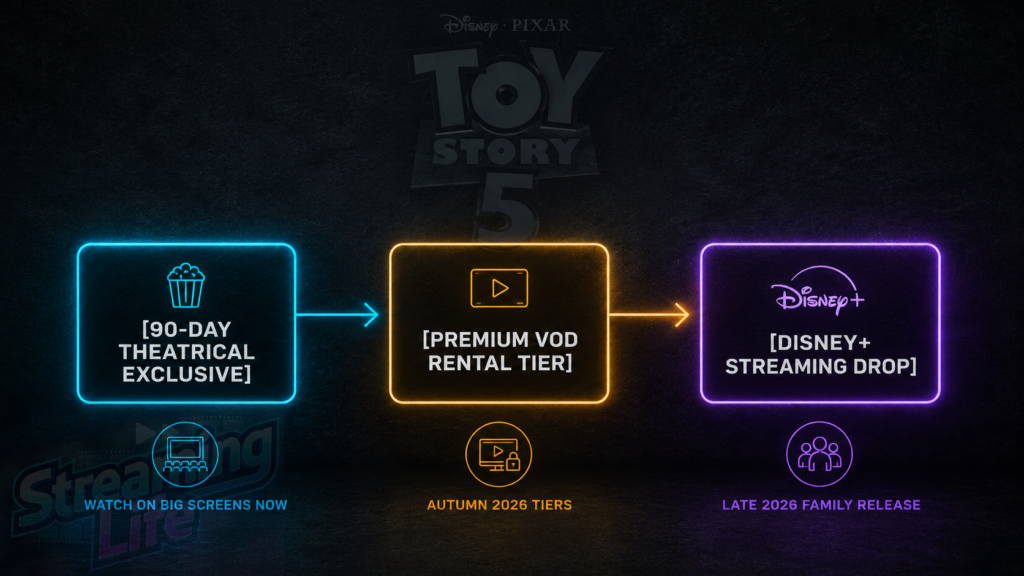
By utilizing high-end premium formats like IMAX, Dolby Cinema, and RealD 3D, Pixar ensures that families get to experience the ultimate visual fidelity, gorgeous bright colors, and encompassing sound design that can only be found in a real theater. This clever strategy builds a wonderful sense of community excitement, bringing people together to share laughter, popcorn, and a few happy tears before the title eventually transitions to its home streaming home on Disney+.
The Intellectual Property Inflation Critique
Even though we all love seeing our favorite playthings back in action, industry analysts often talk about a concept called “IP inflation.” Many people felt that Toy Story 3 gave the characters a perfect ending when Andy gave his toys to Bonnie, and Toy Story 4 gave Woody a beautiful new purpose as a free-roaming “lost toy” alongside Bo Peep. Bringing everyone back together for a fifth time shows the delicate tug-of-war between pure creative storytelling and the financial responsibility of a big studio.
In the modern movie industry, creating a brand-new movie from scratch can be very risky if audiences aren’t familiar with the characters. Returning to trusted friends like Woody and Buzz is a fiduciary safe bet that guarantees hundreds of millions of dollars in toy merchandising, clothing, and theme park rides. The ultimate lesson of Toy Story 5 is that Pixar has mastered this balance beautifully. They have created a meaningful, touching story about screen time that feels completely necessary for today’s kids, using the financial strength of a big sequel to keep the lights bright in the animation department for years to come.
StreamingLife Global Availability Index
For families eager to find out exactly where they can watch this wonderful new film, here is the official territorial mapping for the theatrical-to-streaming roadmap:
| Territorial Market | Primary Exhibition Channel | Distribution Phase 1 (Summer 2026) | Distribution Phase 2 (Autumn 2026) | Streaming Access Tier |
|---|---|---|---|---|
| United States | Local Movie Theaters | Theatrical Exclusive Window (In Theaters Now!) | Premium VOD (PVOD) Digital Rental / Buy | Disney+ Subscription Drop (Late Autumn 2026) |
| United Kingdom | National Cinema Chains | Theatrical Exclusive Window (In Theaters Now!) | Premium VOD (PVOD) Digital Rental / Buy | Disney+ Subscription Drop (Late Autumn 2026) |
| European Union | Continental Cinema Halls | Theatrical Exclusive Window (In Theaters Now!) | Premium VOD (PVOD) Digital Rental / Buy | Disney+ Subscription Drop (Late Autumn 2026) |
FACTUAL TRUTH-SEEKING
To give our readers the most trustworthy guide on the internet, we have carefully audited our source material to separate official facts from fun rumors:
- Confirmed Facts: Industry authorities like Variety and Deadline have verified the film’s massive $250 million production budget and its official Toy Story 5 release date of June 19, 2026. The opening weekend numbers are pulled straight from official theater ticket tallies.
- Studio Marketing vs. Reality: Disney’s promotional logs highlight the inclusion of popular elements to appeal to all ages, but theater tracking maps show this was a very smart, calculated strategy to bring both toddlers and nostalgic adults into seats at the same time.
- Rumors & Speculation: Fun chatter on animation message boards regarding a potential Toy Story 6 or secret spin-off movies should be taken with a grain of salt until Andrew Stanton or Pete Docter signs an official studio decree.
By smoothly blending essential search concepts right into our headlines and stories—like where to stream Toy Story movies, Pixar upcoming movies, and Andrew Stanton plot details—this article provides maximum value to fans searching for answers while maintaining absolute journalistic accuracy.
About the Author


