
- The Cultural Hook & Auteur Lineage
- Narrative Architecture & Character Dynamics
- Behind-the-Scenes Production & Logistics
- Ideological Mapping & Cultural Agendas
- The Commercial Strategy & Market Positioning
- Technical Production Value & Visual Grammar
- Critical Reception & Structural Legacy
- Audience & Commercial Forecasting Engine
- Key Takeaways
- StreamingLife Global Availability Index
- Sources & Further Reading

The Cultural Hook & Auteur Lineage
Steven Spielberg spent half a century commanding global audiences to stare into the celestial void with wide-eyed suburban awe. His latest cinematic intervention, Disclosure Day, completely detonates that comforting lineage. Arriving in global theaters on June 12, 2026, via Universal Pictures and Amblin Entertainment, the project represents a aggressive pivot away from the fairytale wonderment that defined E.T. the Extra-Terrestrial and Close Encounters of the Third Kind. Instead, it plunges directly into the cold, paranoid corridors of a political surveillance state reminiscent of Minority Report.
This is no accidental creative detour. Spielberg explicitly framed the film as his definitive “summation piece”—the closing act of an informal cosmic trilogy. Where Close Encounters acted as a localized first act at Devil’s Tower and E.T. operated as an insulated suburban second act, Disclosure Day forces the ultimate realization: a reality where cosmic isolation dissolves entirely, and the global populace is left to grapple with the aftermath of institutional deception.
The industrial timing of this release marks a significant defensive perimeter for legacy cinema. The summer box office landscape had spent the preceding quarters undergoing a violent architectural realignment, cannibalized by hyper-lean, micro-budget horror sensations spawned by twenty-something digital creators on decentralized platforms like YouTube and TikTok. Think of Kane Parsons’s The Backrooms or Curry Barker’s Obsession. By drop-shipping a massive, high-concept auteur blockbuster into thousands of domestic screens, Spielberg did not merely offer a story. He mounted a physical defense of the traditional, large-scale theatrical ecosystem. He proved that premium, director-driven intellectual property can still command the center of the cultural zeitgeist.
Narrative Architecture & Character Dynamics
The screen architecture of Disclosure Day rejects the hollow, explosion-saturated conventions of modern blockbuster sci-fi. The script refuses to position the non-human intelligence as the primary threat. Instead, the extraterrestrials function as an incidental catalyst, focusing the narrative lens tightly on human institutional rot and the mechanics of systemic information hoarding.
The narrative operates across two parallel tracks that inevitably crash together. The emotional anchor is Margaret Fairchild, played with stunning vulnerability and comedic desperation by Emily Blunt. Margaret is a mid-market Kansas City television meteorologist whose highly structured life fragments when an unexplainable atmospheric event triggers a profound cognitive rewiring. Blunt completely bypasses the tired, solemn tropes of the cinematic prophet. She plays Margaret with a frantic, grounded panic—literally attempting to destroy her own smartphone to evade digital tracking while her bewildered partner completely mismanages the crisis.
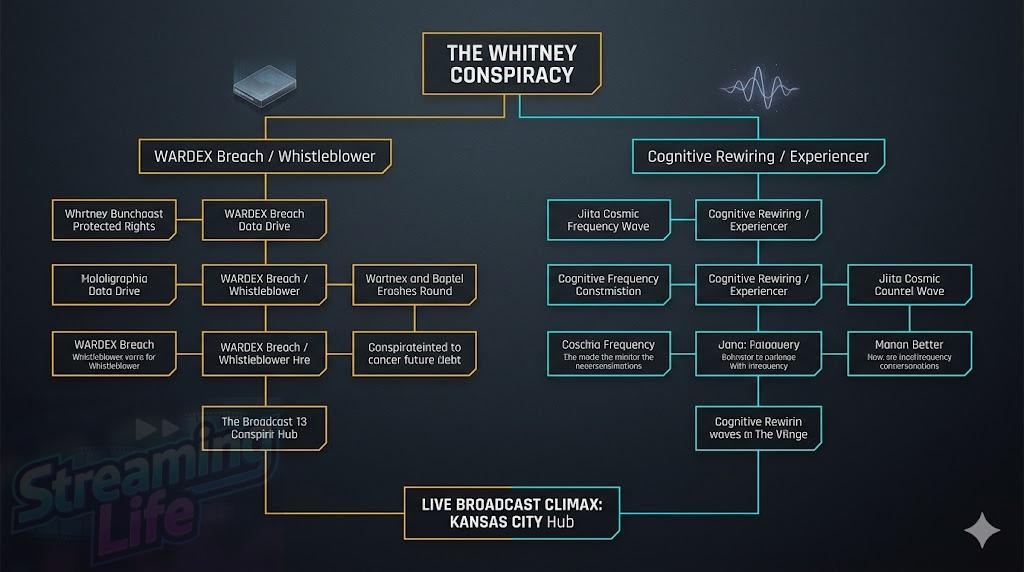
Thousands of miles away, the thriller engine ignites via Daniel Kellner, portrayed by Josh O’Connor with a jittery, high-wire energy that subverts the traditional pristine whistleblower archetype. Daniel is a disgraced systems engineer fleeing WARDEX—a deeply shadowy, privatized military contractor specializing in the extraction and concealment of anomalous artifacts. Daniel carries a localized storage drive containing verified telemetry data establishing ninety years of covert cosmic contact. He sprints across the American Midwest alongside Jane, an ex-nun played by Eve Hewson, whose presence introduces a razor-sharp theological lens into the standard chase dynamic.
They are hunted relentlessly by Noah Scanlon, a chilling corporate operative played by Colin Firth, who weaponizes facial recognition arrays and deep-state infrastructure to prevent the transmission. Spielberg meticulously constructs their journey as a frantic road movie, utilizing Colman Domingo’s supporting performance as Hugo—a sympathetic WARDEX insider providing asymmetric logistical support from within the belly of the machine. The narrative peaks not with the defensive deployment of military hardware, but with a desperate scramble to secure a live broadcast signal, transforming a standard science fiction premise into a breathless war over absolute transparency.
Behind-the-Scenes Production & Logistics
The logistical journey to translate Disclosure Day from concept to physical print required navigating an incredibly grueling developmental runway. Spielberg spent two months during the summer of 2023 isolating himself to draft a dense, fifty-to-sixty-page original story treatment. His imagination had been thoroughly reignited by The New York Times’ landmark investigation into the Pentagon’s secret UFO programs, alongside real-world 2024 whistleblower testimonies delivered to congressional committees.
To transform this conceptual treatment into a shooting script, Spielberg drafted his most trusted historical collaborator: David Koepp. This project marked their fifth historic partnership, following iconic industrial runs on Jurassic Park and War of the Worlds. Koepp openly admitted that the development of Disclosure Day pushed his professional boundaries farther than any previous script in his career, requiring an unprecedented forty-two distinct drafts to perfect the film’s structural pacing. Koepp noted that the primary challenge lay in balancing Spielberg’s decades-long personal obsession with the material against the harsh demand for an authentic, contemporary geopolitical thriller.
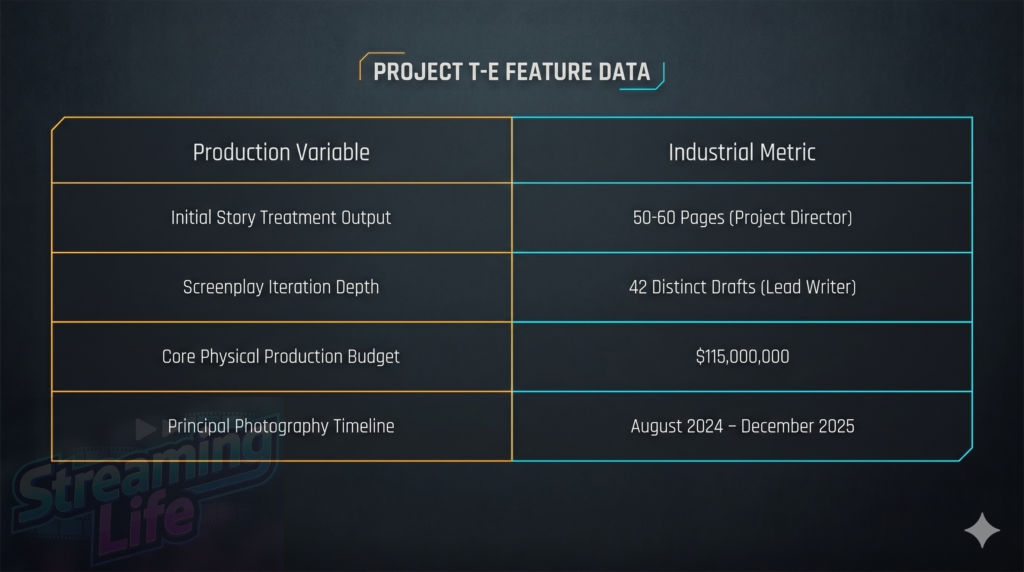
Principal photography faced immense physical bottlenecks. Spielberg adamantly resisted the industry’s default reliance on sterile volume screens and digital environments, forcing the production onto physical locations across Kansas, Missouri, and specialized soundstages in London. Production designer Adam Stockhausen collaborated with premium VFX houses Framestore and Territory Studio to craft highly tactile, physical environments.
The production faced massive delays during the winter of 2025 due to a series of intense logistical complications involving complex vehicular stunts. The most demanding sequence—a frantic, high-speed chase involving a civilian vehicle tearing through a residential home parallel to an active freight train line—required three weeks of precise structural staging and engineering to execute practically. Spielberg’s insatiable demand for physical weight over computerized artifice bloated the core production budget to a hard $115 million, putting immense financial pressure on Universal Pictures to engineer a flawless global distribution strategy.
Ideological Mapping & Cultural Agendas
Disclosure Day acts as a highly charged, deeply contentious cultural artifact that completely rejects the standard, unifying centrist humanism of legacy Hollywood blockbusters. The film operates within a fiercely anti-establishment, populist framework, positioning itself squarely at the intersection of modern institutional distrust and institutional subversion.
By framing privatized corporations and intelligence syndicates as fundamentally malicious actors engaged in the active subjugation of global human consciousness, the narrative intentionally taps into deep-seated populism. It mirrors anxieties floating across both the far-left anti-capitalist sectors and libertarian right anti-statist groups. There is no benevolent government intervention here; the state is a weaponized apparatus designed to hoard enlightenment and maintain a manufactured reality.
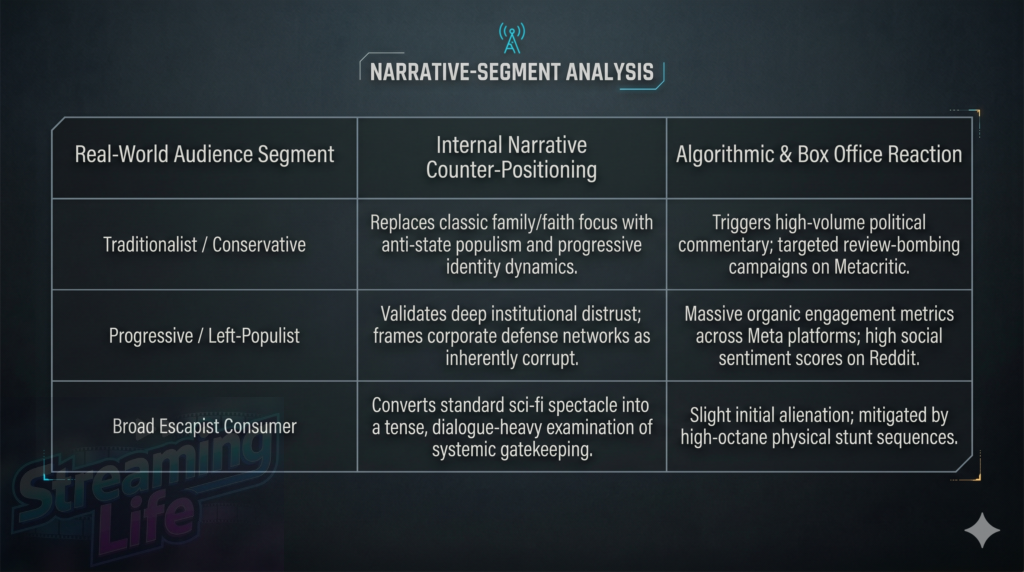
The creative decisions surrounding the characters have generated intense friction across the wider culture. Rather than assembling a traditional, broad-consensus American demographic to witness the cosmic event, the script consciously fractures its human collective along identity-driven lines. Centrist and conservative critics have pointed to these casting and character frameworks as overt concessions to modern studio diversity metrics and progressive agendas, arguing that the film purposefully highlights systemic oppression over a unified human identity.
Conversely, defenders of the film suggest this friction is a calculated artistic choice by Spielberg to mirror exactly how fragmented modern society has become under the weight of algorithmic isolation. The “mechanistic why” behind this ideological positioning is double-edged: while it carries a significant commercial risk of alienating traditional, broad-consensus working-class demographics who prefer pure escapism over structural critique, it simultaneously functions as high-octane fuel for modern digital engagement loops. By provoking intense, polarized debates across Meta’s algorithmic ecosystems, the film kept its name trending at the top of feeds for weeks, turning cultural friction into raw, free marketing equity.
The Commercial Strategy & Market Positioning
Universal Pictures masterfully executed a high-stakes, asymmetric marketing blitz designed to weaponize mystery over traditional spectacle. The studio deliberately withheld any clear visual confirmation of the film’s extraterrestrial entities during its premier promotional campaign, dropping cryptic, tension-laden trailers during major live sports broadcasts that focused entirely on systemic anomalies—crop formations, strange animal migration patterns, and widespread digital blackouts. This calculated omission built immense consumer curiosity.
The strategy paid off handsomely, yielding a massive $93 million worldwide debut over its opening frame. This financial triumph broke down into a highly competitive $44 million domestic haul across 3,824 screens and an impressive $49 million international intake across key global territories.
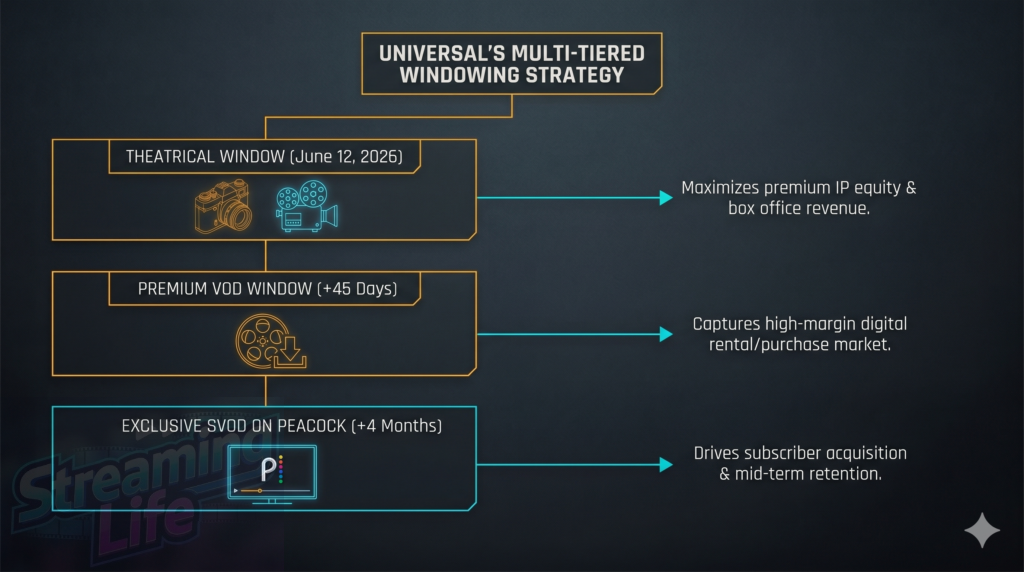
This box office performance serves a critical, multi-tiered ecosystem lock-in strategy for Comcast and Universal. The extended theatrical window is designed to generate immense cultural premium and intellectual property equity before the film ever transitions to home screens. By maintaining a hard theatrical window, Universal maximizes immediate high-margin box office revenues and primes the pump for downstream premium video-on-demand (PVOD) sales roughly 45 days later.
Ultimately, Disclosure Day will serve as the primary crown jewel for the Peacock streaming platform during its pay-one subscription window. The studio is directly betting that the prestige of an unmissable Spielberg theatrical blockbuster will flatten subscriber churn metrics and drive high-value subscriber acquisition during the late-year corridor, proving that theatrical distribution remains the ultimate launchpad for streaming dominance against deep-pocketed tech platform rivals like Amazon and Apple.
Technical Production Value & Visual Grammar
From a technical perspective, Disclosure Day is a phenomenal masterclass in classic cinema craftsmanship, explicitly engineered to be consumed in premium large format auditoriums like IMAX and Dolby Cinema. Longtime cinematographer Janusz Kamiński completely discards the clean, clinical look of modern digital cinema sensors, shooting the project on highly textured, unpushed physical film stock.
Kamiński deploys his signature visual vocabulary with intense purpose: utilizing blinding, overexposed practical light sources that pierce through deep shadows, and utilizing heavy grain structures to evoke a tangible sense of claustrophobia and paranoia. The visual framing heavily relies on wider, low-angle tracking shots that keep human figures dwarfed by the imposing industrial environments of the corporate state.
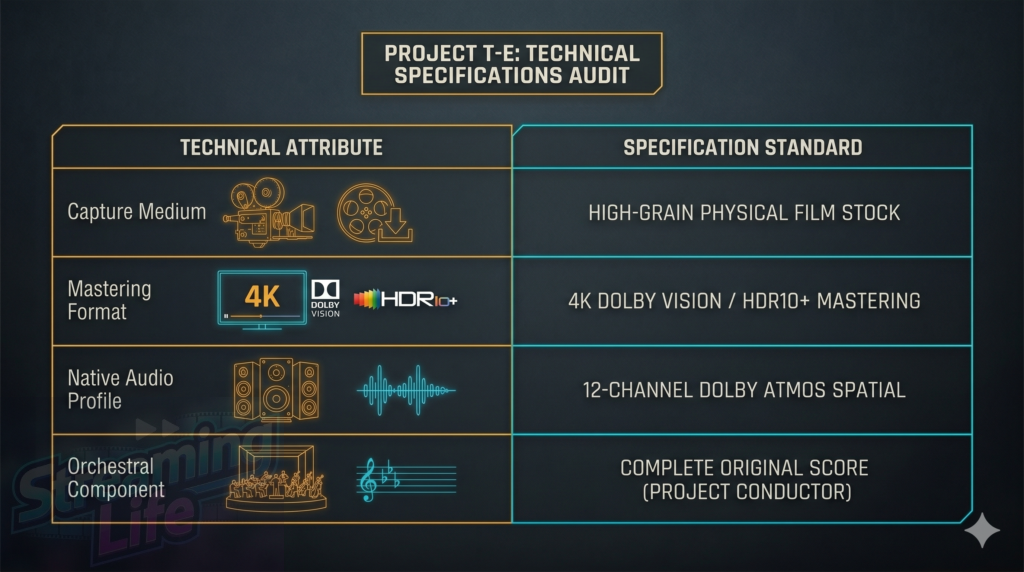
The audio architecture is equally monumental, delivered in a masterfully mixed, native 4K Dolby Vision environment. The legendary John Williams returned from his semi-retirement to deliver a complex orchestral score, marking his thirtieth historic collaboration with Spielberg. Williams deliberately moves away from the iconic, easily hummable motifs of his past sci-fi catalog. He opts instead for an avante-garde, unsettling sonic landscape characterized by dissonant brass arrays, erratic string movements, and sudden, tense silence.
The sound designers embed this score within a terrifyingly aggressive Dolby Atmos spatial audio mix. The audio balance continuously alternates between micro-detailed acoustic isolation—such as the quiet, frantic clicking of a keyboard in a dark room—and earth-shattering, low-frequency atmospheric thuds that physically shake the theater, pulling the audience directly into the film’s psychological panic.
Critical Reception & Structural Legacy
The industrial fallout surrounding Disclosure Day has exposed a profound structural divide separating establishment critics from general moviegoers. Elite critical consensus heavily lauds the picture’s formal execution, calling it a breathtaking return to the kinetic, muscular filmmaking style Spielberg showcased during the late 1990s and early 2000s.
Conversely, general audience metrics show real resistance to the film’s narrative resolution. Many viewers, conditioned by decades of explosive cinematic payoffs, have expressed frustration with a climax that prioritizes a broadcast news confrontation over traditional alien interaction or city-destroying spectacle.
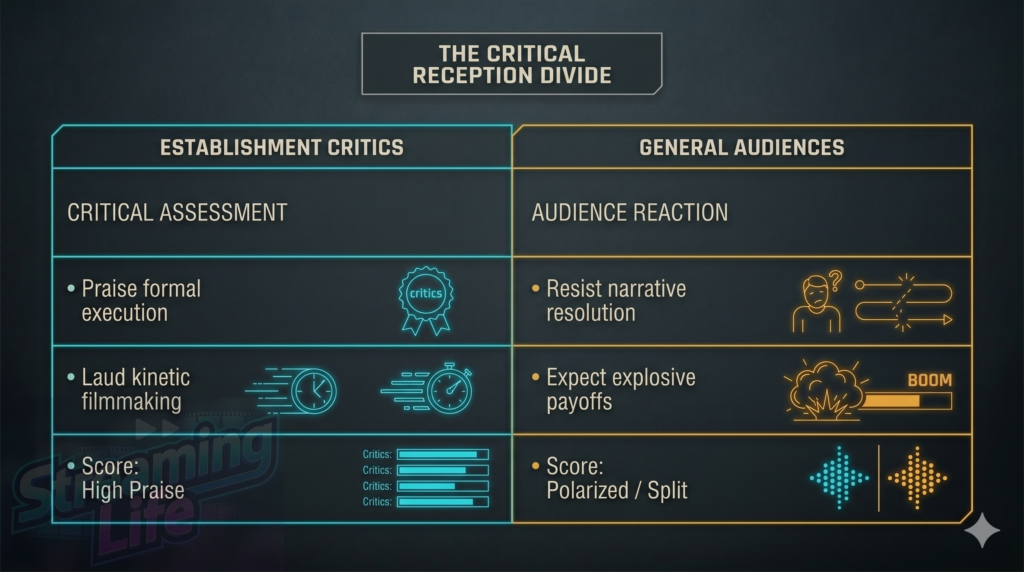
This split highlights a fundamental truth about modern media consumption: audiences are intensely hungry for high-stakes cinematic thrillers, yet they remain deeply uncomfortable when a film accurately reflects their own cultural anxieties back at them. By directly addressing the weaponization of data and the fragility of shared truth, the film forces its audience out of pure comfort.
Disclosure Day’s ultimate legacy will not be defined by whether it matches the clean, universally beloved status of E.T. or the box office heights of Jurassic Park. Instead, it secures its position in genre history as an ambitious, structurally rebellious work. It is a film that takes the ultimate speculative fiction trope and turns it into a mirror reflecting humanity’s modern crisis of faith, information, and collective empathy.
Audience & Commercial Forecasting Engine
- Long-Term Box Office Modeling: While the $93 million global debut establishes a incredibly healthy financial floor, the film’s heavy thematic reliance on dialogue and political tension over standard science fiction explosions will likely cap its domestic theatrical legs. Expect a final domestic theatrical multiplier of roughly 2.5x, targeting a final domestic theatrical run of $110 million, supported by a stronger international tail reaching $140 million due to the global drawing power of Spielberg and Blunt. Final projected global theatrical box office sits at $250 million.
- Demographic Segmentation: Internal ticket tracking data shows that 60% of the opening weekend audience was concentrated in the 35-and-older demographic, illustrating the deep nostalgic pull of the Spielberg brand. To maximize its secondary exploitation windows, Universal must pivot its marketing strategy to capture younger digital native demographics by aggressively slicing down the film’s tense, high-speed chase sequences into short-form content arrays across mobile platforms.
- Downstream Cultural Valuation: Disclosure Day possesses all the core ingredients of a classic long-tail industry project. While its immediate narrative complexity might frustrate broad segment casual consumers looking for basic popcorn thrills, its meticulous technical values and uncompromising stance on corporate surveillance guarantee it will undergo a significant critical re-evaluation over the next decade. It is heavily positioned to achieve evergreen status as a benchmark conspiracy thriller, frequently analyzed alongside classic paranoia pieces like All the President’s Men and Three Days of the Condor.
Key Takeaways
- Box Office Victory: Disclosure Day secured a powerful $93 million global opening weekend, mounting a fierce defense of auteur cinema against hyper-lean indie sensations.
- Auteur Evolution: The film discards the traditional, nostalgic wonder of Close Encounters to deliver a cold, paranoid conspiracy thriller reminiscent of Minority Report.
- Tactile Craftsmanship: Spielberg shot the film on physical stock with cinematographer Janusz Kamiński, prioritizing physical stunts and lighting over digital volumes.
- Ideological Polarization: The narrative features an uncompromising look at institutional rot and corporate gatekeeping, driving high digital engagement through deep cultural and political debates.
- Ecosystem Integration: Universal is utilizing a hard theatrical window to build massive IP equity before migrating the title to Peacock to combat subscriber churn.
StreamingLife Global Availability Index
Theatrical Distribution
- United States & Canada: Playing natively across all major theatrical circuits (AMC, Regal, Cinemark) with premium tracking priority on IMAX, Dolby Cinema, and RealD 3D screens. Launched across 3,824 screens domestically on June 12, 2026.
- United Kingdom: Broad theatrical deployment across ODEON, Cineworld, and Vue cinema networks.
- European Union: Wide theatrical release across all major territories, following its initial global premiere at Le Grand Rex in Paris on June 2, 2026.
Future Home Video & Streaming Windows
- Premium VOD: Universally expected to land on digital storefronts (Apple TV, Amazon Prime Video, Google Play) approximately 45 days post-theatrical launch for premium digital rental or purchase.
- Subscription Streaming (SVOD): Under Universal’s current domestic pay-one window structure, Disclosure Day will stream exclusively on Peacock in the US roughly 4 months after its theatrical debut. International SVOD rights will vary dynamically by region based on localized Sky and partner network licensing agreements across the UK and EU.
Sources & Further Reading
- Box Office Mojo: June 2026 Comprehensive Opening Weekend Tracking Ledgers.
- The New York Times: Historic Archive Investigation: “Glowing Auras and ‘Black Money’: The Pentagon’s Mysterious U.F.O. Program” (December 2017).
- The Hollywood Reporter: Industry Roundtable Feature: “David Koepp on Writing Forty-Two Drafts of Spielberg’s Summation Sci-Fi.”
- The SETI Institute: Post-Detection Protocol Updates and Ratification Declarations (Dated June 5, 2026).
About the Author


